A CNN report claiming that engaging with the arts can slow down the aging process showed up on my social media feed:
The CNN report is strong in its claims. The very first sentence reads, “When it comes to slowing down our biological aging, engaging with arts and culture is as beneficial as physical activity, a new study suggests.” The article (Guy, 2026) also says that the effects are roughly as strong as the impact of physical activity on biological aging.
As a scientist and an advocate for the arts, I was intrigued. However, I was also skeptical. I have encountered research on the supposed effects of the arts on cognition before and always found the evidence to be flimsy. The idea that the arts can have a biological effect seemed extremely unlikely. I’m not even sure how it would occur. What’s the causal mechanism that could cause a person’s visit to an art gallery to make them age more slowly at the cellular level?
I accessed the original report (Fancourt et al., in press) from the journal Innovation in Aging, and found that the methodology does not support any causal interpretation. The authors analyzed archival data from the UK Household Longitudinal Study and found a correlational relationship between “arts engagement” and some markers of biological aging. It is an observational study, which means that it cannot support causal claims about the impact of arts engagement on the outcome variables. (The study had other shortcomings reported in the article, such as relying completely on self-report and combining different arts participation metrics into one scale — but those do not impact whether the design was causal or not.)
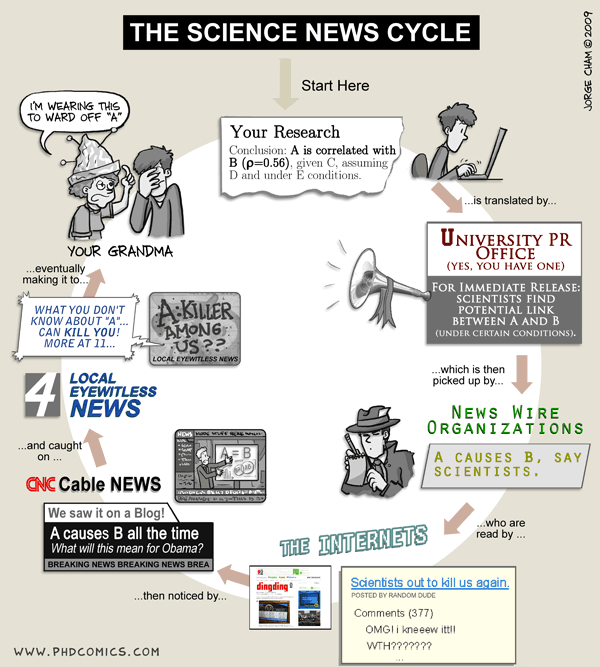
A Game of Telephone
Comparing both, I noticed how much the tone in the article differed from the tone in the CNN report. The original article is cautious. Phrases like “related to,” “associations with,” and “linked to” are used to describe the findings. I could not find any explicit causal claims in the original article, and the authors seem clear that the results are correlational. This is a major difference from the CNN report, which states that engaging with the arts “can slow down biological aging.”
The article also had a press release. It shows a mix of causal and non-causal language. On the one hand, the press release mentions “apparent effects” that “may slow the pace of biological ageing.” On the other hand, the lead author explicitly states:
These results demonstrate the health impact of the arts at a biological level. They provide evidence for arts and cultural engagement to be recognised as a health-promoting behaviour in a similar way to exercise.
–Daisy Fancourt, University College London Institute of Epidemiology & Health Care
The study does not “demonstrate” this at all. It merely states an association — something Fancourt must know, given that is exactly how she and her colleagues worded their conclusions in the original article.
I asked A.I. to evaluate the original article, the press release, and the CNN report and rate them on a scale of 1 to 10. A rating of 1 indicates that there are no declarations or implications of causality in the text. A rating of 10 means that all language declares or implies that the study reported a causal relationship.
The A.I. model (Grok) assigned a rating of 2 to the original article, a 6 to the press release, and 8 to the CNN article. So, as this study moved from a scholarly journal to a popular news outlet, there were stronger statements saying that there was a causal relationship between arts engagement and the biological aging markers. This was a game of telephone that misinforms the public.
How does this happen? Everyone shares some of the blame in this situation. The CNN reporter is chasing clicks, and it’s his job to write the most appealing article possible so that it can get more readers. A simple message and a surprising causal relationship do that better than a wishy-washy article that reports statistical associations. Moreover, the reporter has no scientific training, and so he’s not equipped to make his own judgments of research anyway. The university press office inflated the causal language the most in their quest for media coverage. Finally, the original authors are at fault, too. They know that their study does not show a causal relationship, and yet that didn’t stop them from providing quotes that state that the arts will make people age more slowly.
This happens all the time in science reporting, and it is very frustrating. I don’t see it stopping any time soon because all the major players get what they want out of it: clicks and attention, and there is no mechanism for punishing this kind of behavior. The only loser is the public.
References
Fancourt, D., Masebo, L., Finn, S., Mak, H. W., & Bu, F. (in press). Does leisure activity matter for epigenetic ageing? Analyses of arts engagement and physical activity in the UK Household Longitudinal Study. Innovation in Aging. https://doi.org/10.1093/geroni/igag038
Guy, J. (May 14, 2026). Engaging with arts and culture can slow biological aging as much as exercise, study suggests. CNN. https://www.cnn.com/2026/05/14/health/arts-ageing-study-scli-intl-wellness
