Update: I have expanded this blog post into a peer-reviewed article that has been published in the journal Intelligence & Cognitive Abilities. You can read the article here with no paywall.
In the age of Google and now A.I., humans now have more information at their fingertips than ever before. It has never been easier to get an answer to a factual question, and there is no sign this trend is going to stop or reverse.
It can be tempting for students to say that they don’t need to learn facts because they can just look anything up. The common refrain was, “Why do you need to learn this? I can just look it up on Google.” I remember hearing undergraduate students say this basic question over 15 years ago, but with A.I., this it has become more pressing. After all, ChatGPT needs only seconds to churn out a 5-paragraph essay that would earn an A from almost any high school English teacher. Students are right to question whether they need that skill.
Likewise, A.I. and Google are very good at responding with facts. It is legitimate to ask why anyone should memorize the state capitals or the Krebs cycle when the internet can provide this information instantaneously. So, the question remains: “Why do we have to learn this?”
The Value of Facts
Students need to learn facts because a store of information is the foundation for higher-level thinking and learning. This is shown most clearly in Bloom’s Taxonomy, which puts remembering and recalling fact at the bottom of the hierarchy of learning. This position is not an indication that learning facts is less important than other types of learning, but rather that factual knowledge is a pre-requisite for more complex learning.
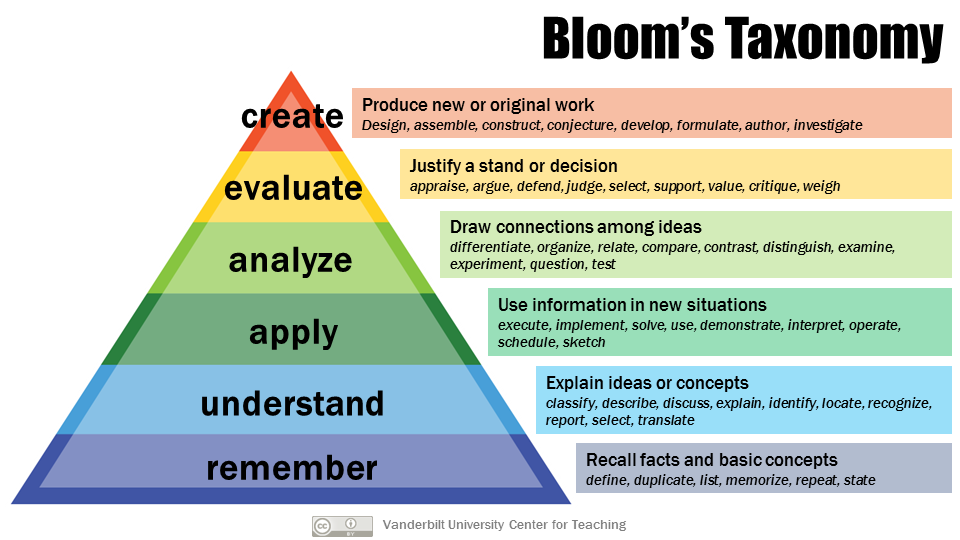
The foundational nature of learning facts is why, for example, creativity is domain-specific (Baer, 2022). Creativity — placed at the top of the pyramid in this illustration of Bloom’s taxonomy — requires a breadth of knowledge about a specific domain or discipline. Before a person can create innovative product or idea, they must first have a strong understanding of the domain and the context. Innovative diplomats know a lot of stuff about statecraft and international relations. The best linguists know a lot of information about different languages and historical change. Creative film directors know a lot about film history, storytelling, camera angles, lighting, and performance.
Creativity is not the only high achievement that requires factual knowledge. Theory building in science also requires factual knowledge. Einstein would never had produced his Theory of Relativity without an in-depth knowledge of physics. Cross-disciplinary work requires knowledge about different disciplines and the ability to see their commonalities and differences. If society want innovative thinkers who can build theories and make connections between fields, then we need people who know a lot of information. Knowledge facilitates insights.
Even if asking all students to be highly creative or to develop new theories not realistic, factual knowledge still represents the starting point for evaluating arguments, weighing options, and drawing conclusions. These are things that modern societies regularly expect their citizens to do when they engage in civic duties (e.g., vote, serve on juries).
A.I.’s Oopsies
More fundamentally, Google and A.I. do not replace learning facts because they are often inaccurate. These tools are not the same as a calculator that produces a correct answer every time (except when user error occurs). Google page rankings do not prioritize truth, and A.I. models cannot surpass the quality of the data they are trained on. When A.I. is trained on incorrect data, then it invariably produces incorrect answers (Warne, 2024).
A.I. models can get even relatively basic information wrong. Last month, my wife searched for information about Obsessive-Compulsive Disorder (OCD). Google’s A.I. search stated that a patient needed both obsessions and compulsions to have OCD. However, this is not true. According to the DSM-5, only obsessions or compulsions need to be present for a person to qualify for a diagnosis of OCD (American Psychiatric Association, 2013). This is pretty basic information about OCD, and yet an A.I. model still got it wrong. Examples like this are a major reason why output from A.I. models needs to still be checked by a human.
Another looming problem with A.I. is the risk of “model collapse.” As A.I.-generated content floods the internet, new A.I. models are trained on their output. As A.I. output seeps into training datasets, defects in the A.I.-generated data get magnified until the result is a model that produces meaningless garbage that bare little resemblance to the original non-A.I. data (Shumailov et al., 2024).

Cognitive Benefits
There are good cognitive and educational reasons to value learning facts. Humans organize related information into a mental organization called a “schema.” As a schema grows (by assimilating additional facts), it becomes easier to learn new related information. In other words, people learn more — and faster — when they already know related facts. A schema helps information get moved into long-term memory more quickly and efficiently, which frees up a student’s working memory as they grapple with a concept.
The benefits of schemas show why discovery learning and other advanced teaching techniques rarely work for K-12 students. Novice learners don’t know enough to quickly understand and assimilate new information they encounter. Without assistance, they often get overwhelmed when trying to organize new information (Kirschner et al., 2006). With a large bank of facts in mind, though, new information can be more easily understood in context, and working memory is less likely to be overloaded.
Conclusion
I hope readers don’t think I am anti-A.I. I now use A.I. almost every day to increase my productivity. It speeds up my work, but it does not absolve me from having my own understanding about the topics I ask it about. I think people should embrace the automation and efficiency that A.I. brings to education and the economy.
In particular, I would be overjoyed if ChatGPT and other LLMs killed the 5-paragraph essay and other formulaic writing. No one enjoys reading boilerplate, and if society reaches a point where humans don’t have to read or write bland boilerplate, then the A.I. revolution will be a plus for mankind.
In education, there is no running from A.I. The best option is not to understand what it is good for (such as writing a cover letter) and what it is not (like theory building or expert analysis). Artificial intelligence may rescue students from writing 5-paragraph essays, but it should not excuse them from learning facts.
References
American Psychiatric Association. (2013). Diagnostic and statistical manual of mental disorders (5th ed.). American Psychiatric Publishing.
Baer, J. (2022). There’s no such thing as creativity: How Plato and 20th century psychology have misled us. Cambridge University Press. https://doi.org/10.1017/9781009064637
Kirschner, P. A., Sweller, J., & Clark, R. E. (2006). Why minimal guidance during instruction does not work: An analysis of the failure of constructivist, discovery, problem-based, experiential, and inquiry-based teaching. Educational Psychologist, 41(2), 75-86. https://doi.org/10.1207/s15326985ep4102_1
Shumailov, I., Shumaylov, Z., Zhao, Y., Papernot, N., Anderson, R., & Gal, Y. (2024). AI models collapse when trained on recursively generated data. Nature, 631(8022), 755-759. https://doi.org/10.1038/s41586-024-07566-y
Warne, R. T. (2024). Lessons about the human mind from artificial intelligence. Skeptic, 29(1), 30-35. https://www.skeptic.com/reading_room/lessons-about-human-mind-from-artificial-intelligence
